Thursday Three - 10 APRIL 2025 

  • 2025-26 Federal Budget – a mixed bag for aged care
  • AAG partners in $4.4m medical research funding for aged care AI tool
  • AJA Member Research Spotlight: AAG thought leaders collaboration


2025-26 Federal Budget –

a mixed bag for aged care

While some aspects of the recently released Federal Budget 2025-26 are welcomed, AAG joins our network partners in ageing and aged care, in our disappointment that more funds have not been directed to vulnerable ageing populations. While we welcome the investment of $662 million to support GP training and growth in the nursing workforce, more must be done to recognise the workforce breaking point currently a reality for hospitals, residential aged care, support at home services and mental health services.

In particular, ongoing issues relating to an inadequate workforce and variations in care quality continue to plague the system. Of concern to AAG members is the lack of sustainability and capacity building of the aged care workforce. While initiatives such as mandatory care minutes, 24/7 RN coverage and pay rises have assisted with the professionalisation of the aged care workforce and improved access to quality clinical care for service users, more needs to be done to improve uptake of allied health professionals within the aged care workforce.

As was a major feature in AAG’s recent submission to the Inspector General of Aged Care on the implementation of the Aged Care Royal Commission Recommendations, the lack of consideration and funding to support older Australians to access quality oral care and dental services was a marked omission from the budget.

Timely access for oral health care remains an ongoing issue for many older people. Often older adults enter aged care with years and decades of dental neglect. With no Seniors Dental Benefits Scheme and lack of Medicare rebate for such services, dental treatments are out of reach for many older people. In addition, personal care assistants, AINS, ENs and RNs would benefit from training in best-practice oral health care, including proper oral care and identifying and responding to oral health issues, especially for those with cognitive decline, dementia, at end-of-life or receiving palliative care.

AAG will continue to advocate for our members and the ageing and aged care sectors in support of appropriate workable solutions and adequate funding within the current government and with any incoming government as a result of the impending Federal election.


AAG partners in $4.4m medical research

funding for aged care AI tool

Congratulations to Dr Nasir Wabe on securing $4.4 million from the National Health and Medical Research Council for his project: A novel AI-augmented digital system for medication deprescribing in residential aged care: the AiCT-Med national cluster randomised controlled trial.

Medication safety is a global concern, particularly in residential aged care (RAC) where polypharmacy is prevalent. Deprescribing is crucial for addressing medication-related issues. The project aims to apply an AI-based digital platform to facilitate deprescribing and improve medication safety in RAC.

Along with Nasir, the chief investigator team includes researchers from the University of Western Australia, Central Adelaide Local Health Network Incorporated, Edith Cowan University, University of Queensland, University of Adelaide, University of Sydney, and University of Technology Sydney.

AAG was happy to support Nasir, an AAG member, and partner in his application. AAG will participate in the project as a contributing member of the steering committee, expert advisory panel and working group, as well as providing advocacy support and promotion of project findings and the development of policy recommendations.

We look forward to bringing you further updates as the project develops.  You can also read more about the project here.


AJA Member Research Spotlight: 

AAG thought leaders collaboration

In our second instalment of our Australasian Journal of Ageing (AJA) member research spotlight series, we are pleased to showcase the following recently published article:

Detection of cognitive impairment, dementia and associated risk factors among Aboriginal and Torres Strait Islander peoples: Retrospective baseline audit
results from a stepped-wedge cluster-randomised controlled trial.’

Led by AAG member Ms Kate Bradley, this study is an excellent example of collaboration among thought leaders on ageing with contributions from multiple co-investigators from across Country, including fellow AAG members Dr Jo-anne Hughson, Prof Dawn Bessarab, Prof Leon Flicker AO, Dr Kate Smith, Assoc Prof Edward Strivens, Prof Irene Blackberry, Ms Robyn Smith, Ms Roslyn Malay, Miss Belinda Ducker, Ms Kylie Sullivan and Dr Dina LoGiudice.

The paper reviews results of documented dementia, cognitive impairment (not dementia) and associated risk factors in patients that attend Aboriginal Community-Controlled Health Organisations (ACCHOs). The findings suggest a need for improved dementia prevention strategies that are culturally responsive for Aboriginal and Torres Strait Islander peoples.

Read the full research article now at AJA online. Access is free for AAG members.

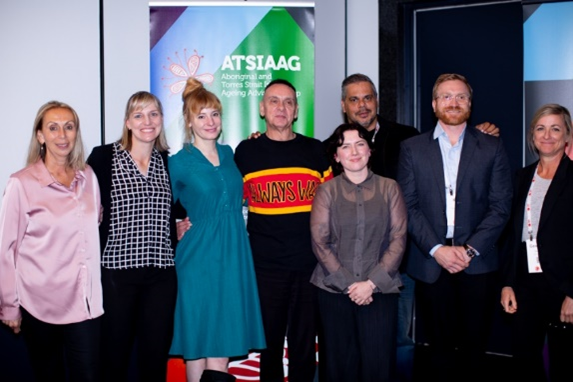
N.B. You may have caught Kate’s joint presentation with Mr Harold Douglas discussing Aboriginal Rainbow Elders’ experiences of discrimination and racism in Australian health care contexts at #AAGConf24. Check out the full abstract of this and other conference proceedings now available on the AAG website

Pictured: Alison Timbery, Jodie Martin, Kate Bradley, Harold Douglas, Penny O'Brien (front), Caleb Rivers, Kevin Taylor and Georgina Chelberg (session chair) at #AAGConf24 in Hobart.