How Ageism Shapes Disease, Disability, and Health Trajectories
By AAG Challenging Ageism Special Interest Group (CHALAGEISMSIG)
We know that the development of health conditions in later life is shaped by a wide range of influences. It is concerning that ageism - stereotypes, prejudice, and discrimination based on age [1] - remains one of the most pervasive yet least acknowledged threats to health equity. While chronic diseases can be common in later life, their prevention and management are deeply influenced by social attitudes. Ageism shapes not only how older people are perceived but also how they experience health and healthcare and policy.
Despite being widespread, ageism is often hidden and widely tolerated. Yet its consequences are profound. Research shows that some of the consequences of ageism for individuals can be poorer physical and mental health, increased risky behaviours, slower recovery from disability, reduced quality of life, and even shortened lifespan. Ageism is also associated with higher rates of depression, anxiety, and chronic conditions such as heart disease, diabetes, and chronic lung disease. [2]
Ageism also has direct implications for healthcare. When health professionals lack age-related knowledge or hold ageist assumptions, including about the usefulness of treatment for older people, this can lead to gaps in diagnosis, inappropriate diagnoses or treatment (including under- or over-diagnosis/treatment) [3], and poor alignment with an older person's priorities.[4] Misunderstandings about multimorbidity, frailty, and polypharmacy can further compromise care.[5] Evidence shows that ageism among professionals can limit access to disease information and reduce availability and appropriateness of treatment options, including for conditions such as cancer.[6, 7]
These dynamics are often expressed through communication - for example, when providers direct conversations to family members rather than patients, attribute symptoms to ageing rather than clinical need, or fail to support older adults in understanding and managing their conditions. Older adults themselves report direct experiences of this. They feel dismissed and excluded and report disrespectful communication and limited involvement in care decisions. Internalised ageism can also lead to older people dismissing their own health symptoms as "just old age".[8]
Such biases compromise person-centred care and erode trust in health systems. Ageist treatment can lead to people withdrawing from preventive services and treatments, compromising health outcomes.[1] Addressing ageism within health professions is therefore essential to ensuring equitable, person-centred care.
Addressing ageism requires systemic action. Education for health professionals must embed age-inclusive principles (strengthening health literacy-focused communication competencies among primary healthcare providers offers one promising, equity-oriented response [9]). Public campaigns should challenge stereotypes and promote intergenerational solidarity. Policy frameworks need to recognise ageism as a determinant of health, influencing everything from workforce planning to service design.
Through research translation, advocacy, and collaboration, AAG ensures that ageism is tackled across sectors. Our Challenging Ageism Special Interest Group (CHALAGEISMSIG) drives this agenda by supporting anti-ageism research and advocacy, promoting intersectional understanding, and amplifying diverse voices.
Combating ageism is not just a moral imperative, it is a public health priority. By dismantling ageist barriers, we unlock better health outcomes, greater health autonomy, and improved quality of life for older Australians.
If you are passionate about promoting rights across the life course and challenging ageism wherever it occurs, we invite you to join the Challenging Ageism SIG. Membership of our SIGs is open to all current financial AAG members.
Looking for more about this issue? Check out this recent webinar on ageism in health, aged care, and disability service systems.
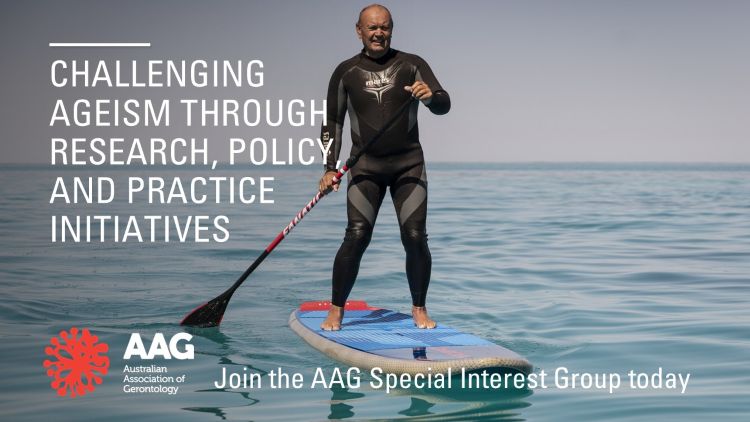
Image credit: Picture Yourself Age Authentic Library
[1] World Health Organization. (n.d.). Ageism. https://www.who.int/health-topics/ageism
[2] World Health Organization. (n.d.). Ageism. https://www.who.int/health-topics/ageism; Allen, J. O., Solway, E., Kirch, M., Singer, D., Kullgren, J., Malani, P. N., & Levy, B. R. (2022). Experiences of everyday ageism and the health of older US adults. JAMA Network Open, 5(6), e2217240. https://doi.org/10.1001/jamanetworkopen.2022.17240; Chang, E. S., Kannoth, S., Levy, S., Wang, S. Y., Lee, J. E., & Levy, B. R. (2020). Global reach of ageism on older persons’ health: A systematic review. PLOS One, 15(1), e0220857. https://doi.org/10.1371/journal.pone.0220857; Jackson, S. E., Hackett, R. A., Steptoe, A., & Wardle, J. (2019). Associations between age discrimination and health and wellbeing: Cross-sectional and prospective analysis of the English Longitudinal Study of Ageing. The Lancet Public Health, 4(4), e200–e208. https://doi.org/10.1016/S2468-2667(19)30035-0; Teaster, P., & Giwa, A. (2023). Ageism as a source of global mental health inequity. AMA Journal of Ethics, 25(10), E765–E770. https://doi.org/10.1001/amajethics.2023.765
[3] Agency for Clinical Innovation. (2019). Over-diagnosis and over-treatment in the frail elderly. https://aci.health.nsw.gov.au/__data/assets/pdf_file/0003/561846/ACI-Aged-Frailty-elderly-report.pdf
[4] Festen, S., Stegmann, M. E., Prins, A., van Munster, B. C., van Leeuwen, B. L., Halmos, G. B., de Graeff, P., & Brandenbarg, D. (2021). How well do healthcare professionals know the priorities of their older patients regarding treatment outcomes? Patient Education and Counseling, 104(9), 2358–2363. https://doi.org/10.1016/j.pec.2021.02.044
[5] Gazaway, S. B., Barnett, M. D., Bowman, E. H., et al. (2021). Health professionals’ palliative care education for older adults: Overcoming ageism, racism, and gender bias. Current Geriatrics Reports, 10, 148–156. https://doi.org/10.1007/s13670-021-00365-7
[6] Neal, D., Morgan, J. L., Kenny, R., Ormerod, T., & Reed, M. W. R. (2022). Is there evidence of age bias in breast cancer health care professionals’ treatment of older patients? European Journal of Surgical Oncology, 48(12), 2401–2407. https://doi.org/10.1016/j.ejso.2022.07.003;
[7] Shin, D. W., Park, K., Jeong, A., Yang, H. K., Kim, S. Y., Cho, M., & Park, J. H. (2019). Experience with age discrimination and attitudes toward ageism in older patients with cancer and their caregivers: A nationwide Korean survey. Journal of Geriatric Oncology, 10(3), 459–464. https://doi.org/10.1016/j.jgo.2018.09.006
[8] Australian Human Rights Commission. (2025). The age barrier: Older adults’ experiences of ageism in health care. Australian Human Rights Commission.
[9] O’Brien, L. M., Lawless, M., & Ambagtsheer, R. C. (2025). Health literacy–focused communication training for primary healthcare providers working with older adults: A scoping review. Geriatric Nursing, 66(Part A). https://doi.org/10.1016/j.gerinurse.2025.103601