Jules Renard, a French novelist and playwright, once said “It’s not how old you are, it’s how you are old.”
As we age, physical activity is more important than ever. Being active does not only promote fitness, it promotes independence and quality of life. Regular physical activity maintains strength, flexibility, balance and cardiovascular health – all critical for daily life and falls prevention. Physical activity can also improve sleep, mood and cognitive function, and help manage or even prevent chronic conditions. Yet many older people are inactive, especially older adults using aged care services. Key barriers to being active include fear of injury, not knowing where to start and lack of social support.
Unfortunately, generic information and exercise programs consistently fail to engage older people (or, indeed, anyone!). One promising solution lies in creating exercise programs with older people, rather than for them, using co-design.
Co-design is a collaborative approach that involves the people who use programs, services and digital tools in their designs. Instead of assuming what older people need or want, co-design involves them as active partners in describing problems and identifying as well as testing solutions.
We used co-design in a small study funded by the AAG Research Trust’s Hal Kendig Research Development Program. This study built on previous work co-designing an exercise program with aged care service users, support workers and physiotherapists. The program, called TOP UP, supports increased mobility for older people receiving ages care services by combining telehealth physiotherapy with local support from aged care workers, using aged-friendly information and exercise videos.
Though a popular program that supported increased mobility and falls prevention, accessibility and engagement could be improved with a more user-friendly website.
Working with aged care service users, support workers and physiotherapists, the co-design process involved iterative interviews and test-and-feedback sessions using a website prototype. This led to the identification of eight key design features (illustrated below):
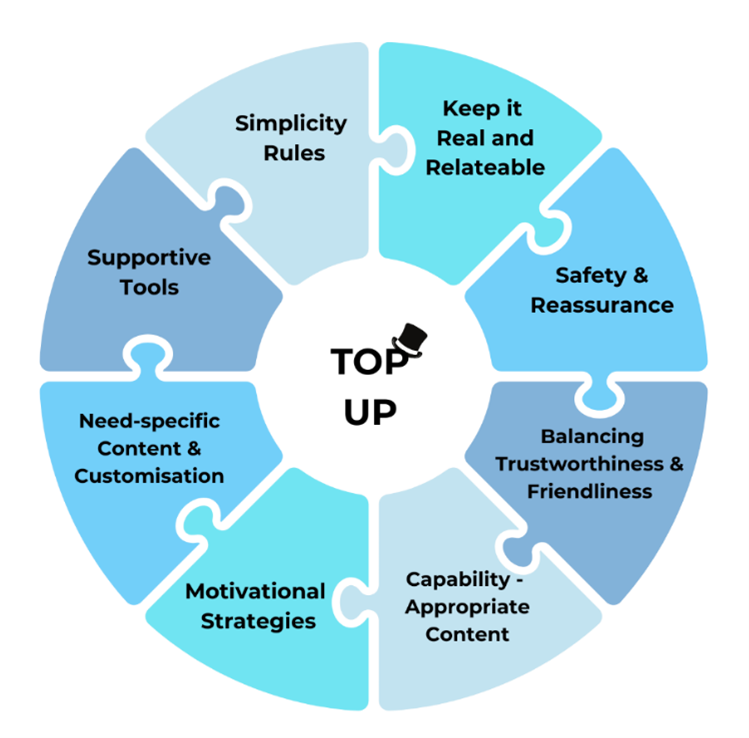
In addition, participants reported improvements in the website’s readability, navigation, functionality, content and engagement. They also enjoyed the co-design process, with one participate stating:
“As an older person you get to think that you’ve been forgotten.… I get a thrill out of being able to do this. It makes me think that you want to know how I think about it all. When you get to my age you just wonder what’s around the corner but now I’m engrossed in this and I’m happy to be doing it.” (Male aged care service user, 90 yrs).
It is hoped that the co-designed website will support the TOP UP delivery in aged care services across Australia, including regional and rural areas with limited physiotherapy access.
Healthy ageing isn’t just about adding years to life – it’s about adding life to years. Physical activity is key to that equation. Co-design provides an effective, respectful way to develop programs and tools that matter to older adults and can help them stay active, connected, and confident as they age.